What’s the true nature of the relationship between brain, mind and consciousness? How does ayahuasca, the famous amazonian medicine and psychedelic sacrament used in distinct socio-cultural settings, modify brain activity influencing consciousness in such a profound, unique and fascinating manner?
These and other research questions can be studied by neuroscientific techniques such as the electroencephalogram (EEG), which continuously measures the brain’s electrical oscillations.
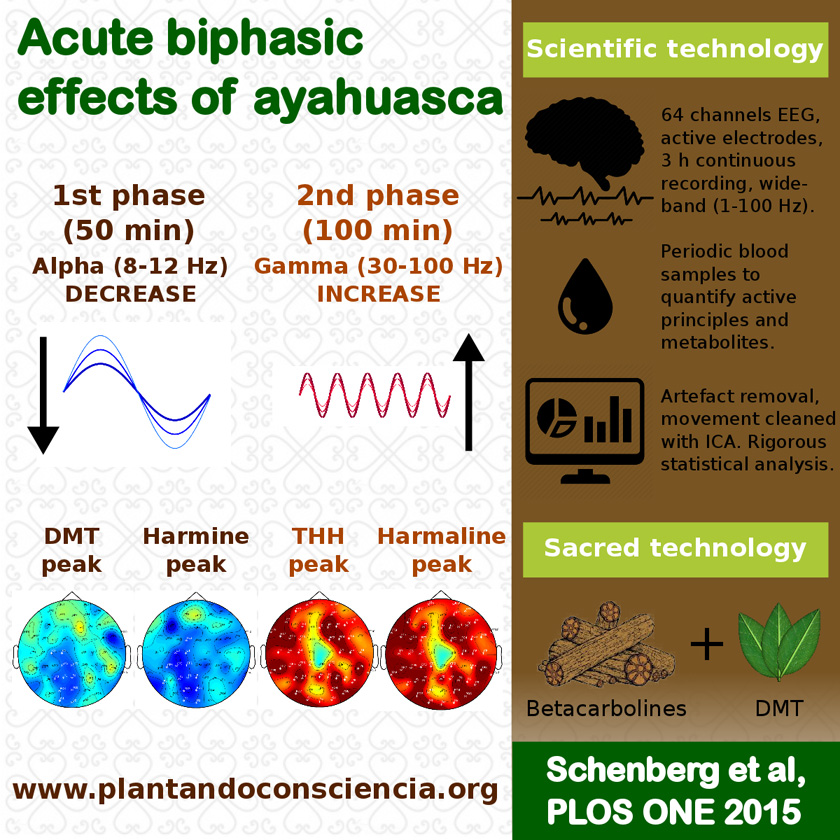
Conducted between 2011 and 2015 at the Federal University of São Paulo (UNIFESP), this research was published at PLOS ONE in Spetember 2015 (Schenberg et al) and showed for the first time that ayahuasca effects biphasic effects in the brain.
In other words, ayahuasca elicits modifications of consciousness that vary qualitatively over time. The research also showed that these effects can not be solely explained based on the actions of N,N-dimethyltriptamine (DMT), further expanding current notions about ayahuasca’s pharmacological mechanism of action.
Next steps include researching connectivity measures in source space and exploring the fractal dimension of the brain signal before and during ayahuasca’s effects.
These and other research questions can be studied by neuroscientific techniques such as the electroencephalogram (EEG), which continuously measures the brain’s electrical oscillations.
Conducted between 2011 and 2015 at the Federal University of São Paulo (UNIFESP), this research was published at PLOS ONE in Spetember 2015 (Schenberg et al) and showed for the first time that ayahuasca effects biphasic effects in the brain.
In other words, ayahuasca elicits modifications of consciousness that vary qualitatively over time. The research also showed that these effects can not be solely explained based on the actions of N,N-dimethyltriptamine (DMT), further expanding current notions about ayahuasca’s pharmacological mechanism of action.
Next steps include researching connectivity measures in source space and exploring the fractal dimension of the brain signal before and during ayahuasca’s effects.
 Neuro-biochemical study of the physiological effects of ayahuasca completed and published.
Further studies are being drafted. Open for funding.
Acute Biphasic Effects of Ayahuasca [PLoS ONE 10(9), 2015]
Read the abstract or
Read the full article (open access).
Praise for the article:
“Wonderful research, congratulations, in particular for its thorough nature. This is probably the best brain work ever on a hallucinogen.” Jeremy Narby, PhD.
“Excellent research. I wonder what’s next.” Ede Frecska, PhD.
“Great recent publication in PLOS ONE. Stellar work!” Peter Hendricks, PhD.
“Probably the best article I read on EEG & ayahuasca” Enzo Tagliazucchi, physicist and neuroscientist.
 NEWSLETTER